Water service line
Signs Your Water Service Line Needs Repair
Soggy ground, low pressure, a spinning meter, rusty water: seven signs the buried pipe between your meter and house is failing, and what each one means.
Read the guide →
Water service line repair · San Luis Obispo
Your service line is the buried pipe from the City water meter to your home — and in San Luis Obispo, it's the owner's to fix. Our technicians find the damaged section and repair it properly.
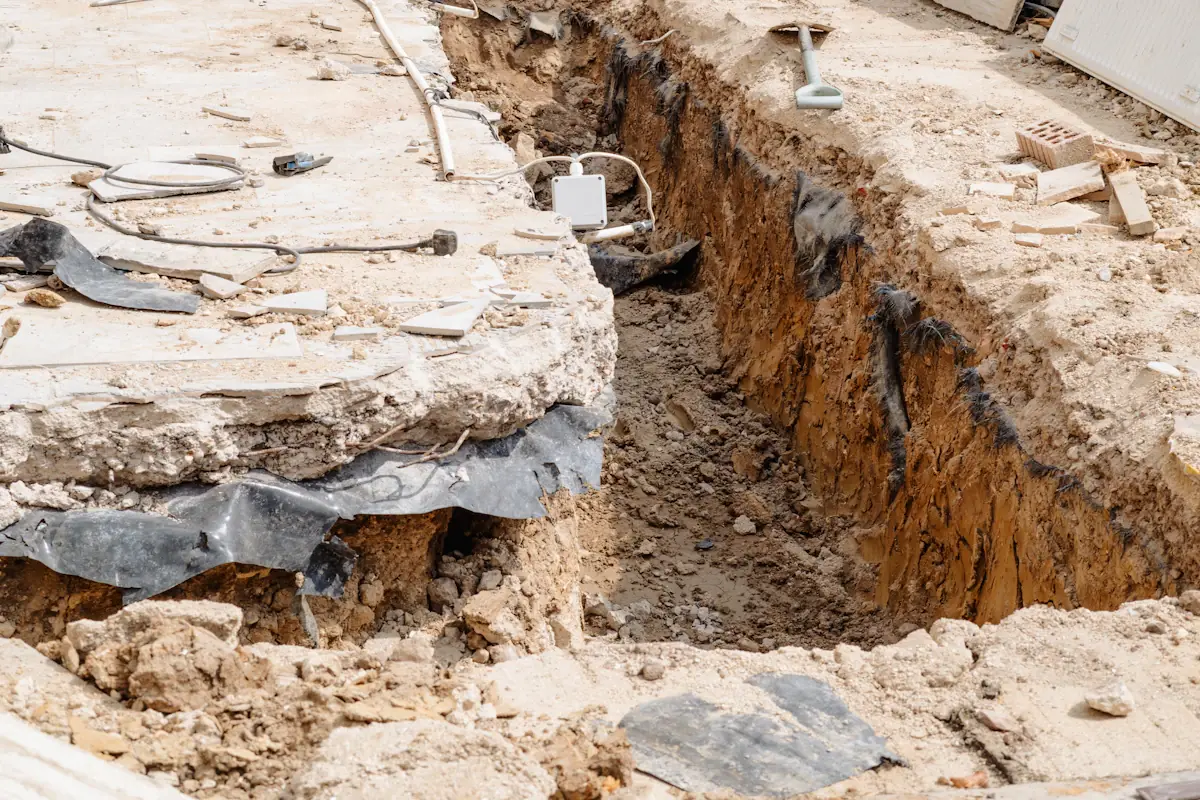
Water service line repair fixes a leak, crack, or failed fitting in the private pipe between your water meter and your building — the section San Luis Obispo's municipal code calls the "private service line" and makes the owner's responsibility. We trace the line, pinpoint the failure with acoustic or tracer-gas equipment, expose that spot, replace the damaged section, and pressure-test before backfilling. Most single-point failures don't need a full line replacement.
A water service line is the pipe that carries drinking water from the public system to your building. In San Luis Obispo it has two owners. The City operates and maintains the section from its water main up to and including the meter, which normally sits in a box in the sidewalk. From the meter onward, the pipe is yours — the municipal code defines it as the private service line, running from the City's meter to the point of entry of your home or irrigation system.
On a typical single-family lot, that private line is a relatively short, buried run — often ¾-inch or 1-inch pipe — that crosses the front yard or runs under a walkway or driveway to a hose bib or riser near the foundation. It's under constant pressure 24 hours a day, which is why even a small defect eventually becomes a leak.
Most service line calls come down to one of these failures. All of them are usually fixable without replacing the whole line, as long as the rest of the pipe is in reasonable shape:
A damaged service line shows up outside before it shows up inside. Watch for a lawn strip that stays wet between the meter and the house, water seeping up at the meter box on the house side, pressure that has dropped at every fixture at once, or a meter that keeps registering after you've shut off the building valve. A sudden rise in usage on your bill — or a leak notification from the City's AMI smart-meter portal — is often the first clue. If you're mainly chasing a leak you can't see, our guide to water line leak repair goes deeper into diagnosis.
Our crew follows the same sequence on every job:
A spot repair is the right call when the leak is a single, identifiable defect and the pipe on either side is sound. That's the most common outcome. Once the pipe is exposed, though, we can see its condition — and that's when the conversation sometimes changes. We'll tell you plainly what we find.
| Pipe material | Typical failure | Repair outlook |
|---|---|---|
| Galvanized steel | Internal rust, leaks at threads, reduced flow | Spot repairs are often short-lived on badly corroded pipe; replacement is commonly recommended. |
| Copper | Pinholes, cracked or failed joints | Usually a good candidate for section repair. |
| Polybutylene (gray plastic) | Failures at fittings, brittleness | Repairs are possible, but replacement is usually advised. |
| Polyethylene / PEX | Damage from digging, fitting failures | Generally repairable with the correct fittings. |
| PVC | Cracks from ground movement, glued-joint failure | Generally repairable; check for repeated movement. |
If we recommend replacement, we'll show you what we saw and explain why — and it's always your decision.
We repair service lines citywide: from the older streets of Downtown and Old Town — where original galvanized lines still turn up — to the 1960s–70s homes around Laguna Lake and the newer neighborhoods of Edna-Islay and the Orcutt Area. We also work for rental owners near Cal Poly in the Foothill area. If you're not sure this is a service line issue, start with our water line repair in San Luis Obispo overview.
Every job is scoped on its own facts. The biggest drivers are how quickly the leak can be pinpointed, how deep the pipe is, what sits on top of it (turf, pavers or concrete), how many fittings are needed to join new pipe to the old material, and whether surface restoration or a permit is part of the job. We give you a written quote that lists what's included and what's excluded before any work starts.
None of these are required, but they help us diagnose over the phone and arrive with the right equipment.
Close the building shut-off and see if the meter still moves. The City's leak guide shows how.
Where is the wet spot relative to the meter and the house? Is it near a sprinkler valve or a hose bib?
What's coming out of the ground by the house — gray, copper-colored, or dull metal? It hints at the material.
Background reading before you call.
Water service line
Soggy ground, low pressure, a spinning meter, rusty water: seven signs the buried pipe between your meter and house is failing, and what each one means.
Read the guide →Water service line
A 15-minute check to find out whether a leak is in your water service line, your irrigation or the house, using the valves and meter you already have.
Read the guide →Water service line
Age, corrosion, shifting clay soil, roots, pressure surges and a stray shovel: why water service lines fail, with the San Luis Obispo angle on each.
Read the guide →Here's exactly what happens when you call WaterFlow Solutions — no surprises.
Yes, the portion after the meter is. The City maintains the pipe from the main up to and including the meter; the customer's responsibility begins after the meter and runs to the building (City of San Luis Obispo).
Good question to ask before we dig — upsizing from ¾-inch to 1-inch is straightforward while the trench is open and gives you room for future irrigation. Tell us about your plans when you call and we'll size the new line accordingly.
A straightforward spot repair on an easily reached line is often completed in a single visit once the leak is located. Hard-to-find leaks, deep pipe, concrete removal, or a full replacement take longer. We give you a realistic timeline after assessing the site.
It depends entirely on your policy. Some policies exclude the underground service line; others cover resulting damage or offer a service-line endorsement. Check your policy or ask your agent before work starts, and keep photos and our invoice.
A leak near the foundation keeps soil saturated, and in clay-rich soils that can contribute to movement. That's one reason not to leave a service line leak running for weeks, even a small one.
Permit requirements depend on the scope of work — a small repair and a full replacement may be treated differently. We know the City of San Luis Obispo's current requirements and will tell you if a permit is needed.
Call (805) 285-4654 and describe what you're seeing. We answer 24/7 — free to call, no obligation. We'll come out, locate the problem, and give you a written quote before any work starts.