
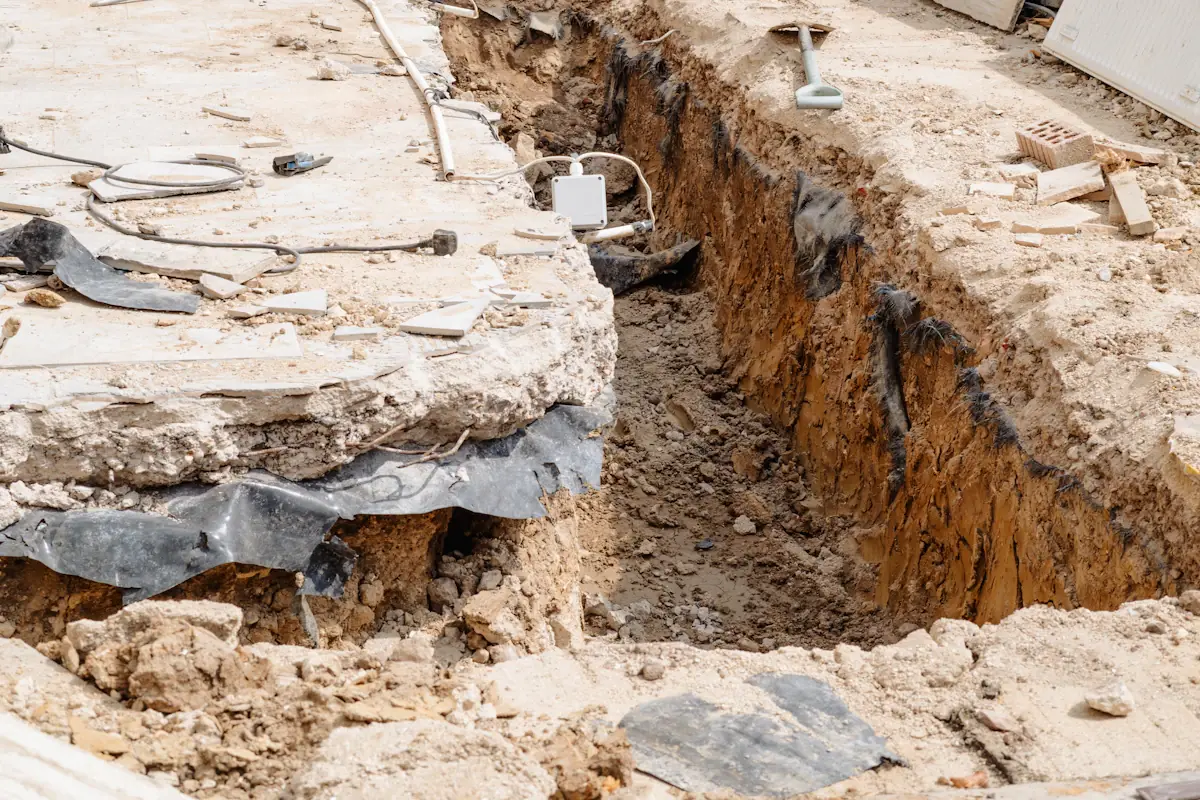
The pipe feeding your house is buried and out of sight, so it sends small signals first. The strongest single sign is wet ground between the meter and the house during dry weather; a meter that keeps moving with the building valve closed confirms an outside leak. Two or more signs together almost always justify having us take a look.
Think of your water service line as a garden hose buried under your front yard and left under pressure every hour of every day for decades. In San Luis Obispo it runs from the City's meter — usually in a box at the sidewalk — to the point where water enters your home. The City maintains everything up to and including the meter; the stretch after it belongs to the property owner (City of San Luis Obispo).
1. A patch of ground that won't dry out
This is the classic. A strip of lawn, a planter bed, or the soil beside a walkway stays damp, spongy, or noticeably greener than everything around it, even after days without rain or irrigation. Water escaping from a pressurized pipe has to go somewhere, and it often rises along the soft backfill of the original trench. If the wet area sits roughly on a line between the meter box and the house, the service line is the prime suspect.
2. The meter moves when nothing is running
Your meter is the most honest witness you have. Turn off every tap, appliance, and irrigation zone, then look at the meter's low-flow indicator. If it keeps turning, water is leaving the system somewhere. Close the main building shut-off and look again: if it still moves, the leak is outside the house. Our step-by-step meter check walks through it.
3. Pressure drops across the whole house
One weak shower is usually a fixture problem. Every tap weakening at the same time is different. A service line leak lets some of the flow escape before it reaches you, and a corroded galvanized line narrows internally until it simply can't deliver enough water. Either way, the pattern is whole-house, not one room. See why water pressure suddenly drops for how to tell the causes apart.
4. A water bill that doesn't match your habits
Compare your bill with the same period last year. If usage has jumped and nothing has changed at home — no guests, no new landscaping, no pool — a hidden leak is likely. Many San Luis Obispo meters now carry smart (AMI) radios, and the City's customer portal lets you set leak notification thresholds, which can flag continuous flow before the bill arrives.
5. The sound of running water with everything off
Stand near the meter box, the hose bib closest to the street, or where the pipe enters the house on a quiet evening. A steady hiss or trickle when every fixture is off is worth investigating. Sound travels well along metal pipe, so on copper or galvanized lines you may hear a leak some distance from where it actually is.
6. Rusty or discolored water
Brown or orange water at the first draw that clears after running can point to corroding galvanized steel — still found in many of SLO's older homes. It isn't proof of a leak, but it tells you the pipe is deteriorating from the inside. That matters when you're deciding whether to repair or replace.
7. Sinking or cracking along the pipe's path
Escaping water carries soil with it. Over time that can leave a soft depression in the lawn, a walkway slab that has dropped at one end, or new cracks in a driveway above the line. Keep cars and people off any area that feels hollow, and don't wait on this one.
How serious is it?
| What you see | What it usually means | Urgency |
|---|---|---|
| Rusty water only | Aging galvanized pipe | Plan an assessment |
| High bill, meter moving | Hidden leak, likely outside | Within days |
| Persistent wet patch | Active service line leak | Within days |
| Whole-house pressure loss | Significant leak or break | Soon |
| Sinking ground, water surfacing | Large leak undermining soil | Shut off water and call now |
What to do next
Run the meter test first — it takes a couple of minutes and tells you whether the problem is inside or outside. If it points outside, our guide to water service line repair explains how we locate the damaged section and fix it. For a broader overview of the local rules and repair process, see our main page on water line repair in San Luis Obispo.
Frequently asked questions
Which sign should I never ignore?
Sinking or hollow-feeling ground along the pipe's path. It means escaping water is carrying soil away under the surface — undermining lawns, walkways, and potentially foundations. Shut off your customer valve and call us right away.
Rusty water but no leak — do I need a repair?
Not necessarily today, but it's a warning. Rusty water means a galvanized line is corroding from the inside, and corrosion is what eventually causes leaks and pressure loss. It's the right time for an assessment and a plan — not an emergency, but not something to forget about either.
Can a service line leak damage my foundation?
A long-running leak can saturate soil against a foundation and undermine slabs, walkways, and driveways. It's one of the real costs of waiting: the leak itself is fixable, but the secondary damage it causes while you wait often isn't cheap to undo. If you see sinking ground, don't put it off.
I have two of these signs — what now?
Do the meter test to confirm it's outside the house, then call us. Two signs together — say, a wet patch plus a moving meter — is about as certain as it gets without digging. We'll pinpoint the exact spot and give you a written quote before any work starts.