
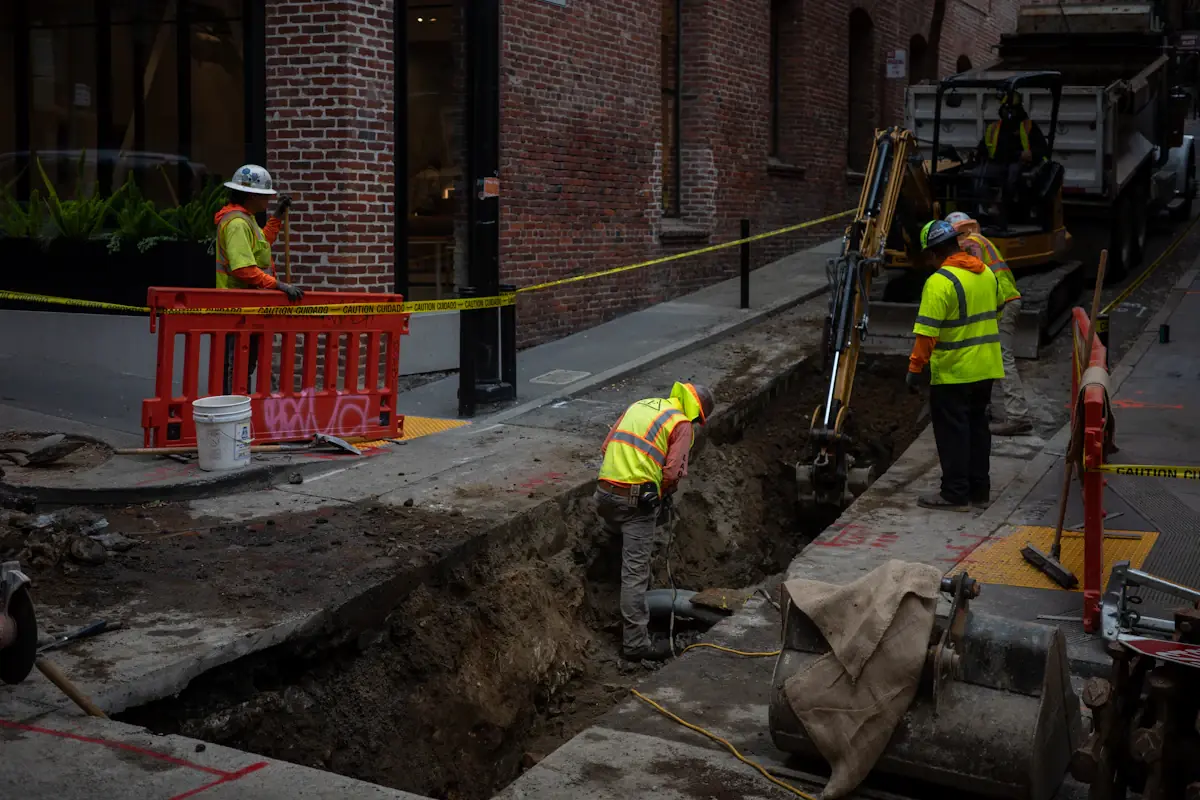
A water service line repair runs in six stages: assessment, leak location, access, the repair itself, pressure testing and flushing, then backfill and restoration. The water is only off while the damaged section is cut out and replaced — most of the job happens with your water on.
Stage 1: Assessment
We confirm the leak is on the service line — not inside the house or in the irrigation. Expect questions about what you've noticed, and a meter check with the building shut-off and irrigation isolated.
Your part: share what you've seen, any meter test results, and when the house was last replumbed if you know.
Stage 2: Locating the leak
We trace the pipe's route and pinpoint the leak using acoustic listening, tracer gas, or pressure testing, depending on the pipe and site. This is what keeps the dig small. Our guide to finding underground leaks explains the methods.
Your part: point out sprinkler lines, low-voltage lighting, and your sewer cleanout — these aren't marked by public utility locating.
Stage 3: Accessing the pipe
Before excavating, we contact 811 so public underground utilities are marked — California law requires this notice ahead of digging. Then we open an access hole over the leak: by hand near other utilities or roots, or with a small machine where there's room. Turf is cut and set aside; pavers lifted; concrete saw-cut only if unavoidable.
Your part: clear vehicles, planters, and furniture; keep kids and pets away from the open hole.
Stage 4: The repair
With the pipe exposed, we inspect it on either side of the damage. If it's sound, we shut the water off, cut out the damaged section or fitting, and join new pipe with couplings rated for the material — including proper transition fittings where materials change. If the pipe is badly deteriorated, this is when we may recommend replacement; see our repair-or-replace guide for how we make that call.
Your part: fill a few containers before the shut-off; ask to see the damaged pipe — we're happy to show you.
Stage 5: Testing and flushing
We turn the water back on slowly (to avoid pressure shock) and check the repair under pressure with the hole still open. Then we run taps to purge air and any loosened sediment. Expect some sputtering and cloudy water briefly — that's normal.
Stage 6: Backfill and restoration
Soil goes back in layers and is compacted to reduce later settling. Turf is replaced or the area raked; hardscape is relaid or patched depending on what the written quote includes.
Your part: check the meter a day later with everything off (it should be still), and watch the area for settling after the first rains. If anything looks off, call us — our warranty covers the repair.
Before the day: questions to ask
- Is a permit needed, and who arranges it?
- How long will the water be off?
- What surface restoration is included?
- What warranty applies to the repair?
We answer all four in our written quote before any work starts — no surprises.
For the full picture, see water service line repair, and if the pipe is under hardscape or deep, underground water line repair. Our homepage has more on water line repair services in San Luis Obispo.
Do I need to be home during the repair?
It's good to be reachable for the assessment and the shut-off, but you don't need to supervise. We walk you through the plan, give you a written quote, and keep you updated as the work progresses.
How long will my water be off?
Only while we cut out and replace the damaged section. Locating, digging, testing, and backfill all happen with the water on or turned back on between steps. We warn you before the shut-off.
Will you damage my landscaping?
We plan the access point to avoid major roots and plantings, hand-dig near anything valuable, and set turf and pavers aside for replacement. Tell us about anything you want protected when we assess the job.
Do you warranty the repair?
Yes. Our repairs are backed by our warranty on labor and materials. We explain exactly what it covers in the written quote — ask us about it when we assess the job.
What should I ask before the work starts?
The four questions above: permit, water-off time, restoration included, and warranty. Any contractor doing this work should answer all four clearly before digging — we do.